Why AI Adoption Stalls: Closing the Integration Gap | The Square Wave
I had a conversation with a senior leader recently who told me their organisation had rolled out AI tools across the entire business. Licenses purchased, access granted, a training session or two ticked off. And yet, when I asked how it was going, she paused before saying, "honestly, I'm not sure anyone is really using it."
That pause says everything, because it's the most common thing I hear right now.
Most organisations already have AI. The tools are there, the investment has been made, and some early adopters are moving quickly and getting real results. But beneath the surface, adoption is uneven, outputs are inconsistent, and a quiet group of people are either avoiding it entirely or using it in ways nobody has sanctioned. Leaders are unsure how hard to push, and the gap between what AI could do and what it's actually doing for the business keeps quietly widening.
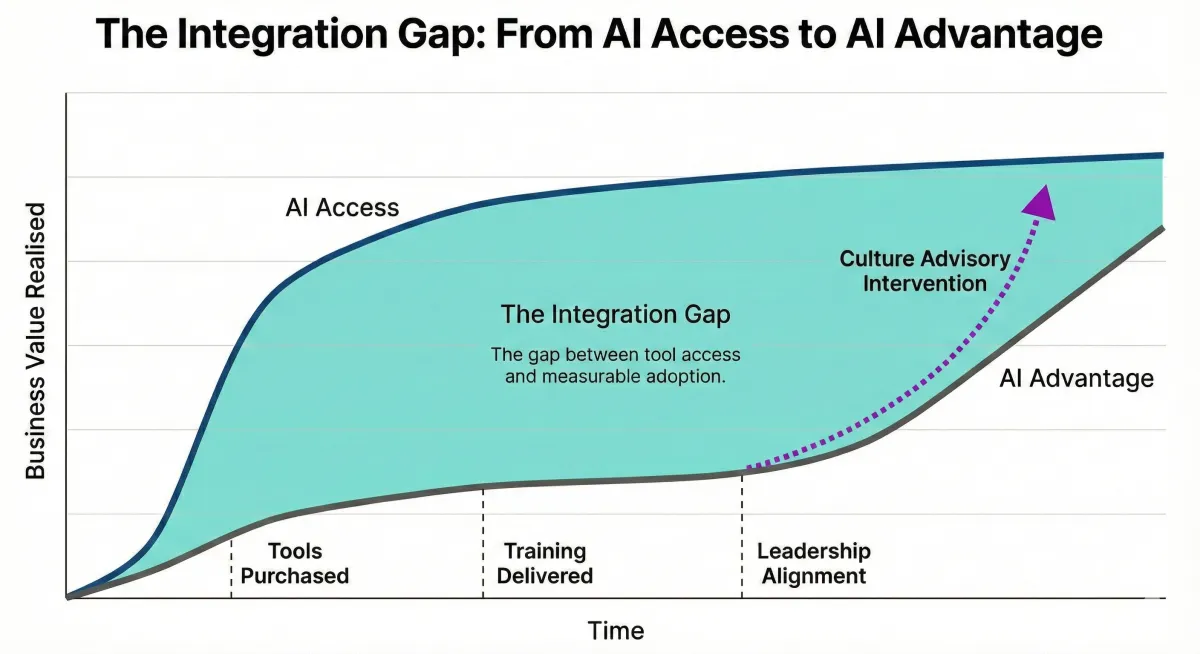
This is what we call the Integration Gap: the space between having AI and genuinely benefiting from it.
Access is not the same as capability
Giving someone a login to ChatGPT is not the same as teaching them how to think with it, and this is where so many organisations have stumbled in the first wave of adoption. The focus went to tools, which made sense at the time, but what got skipped was everything that makes a tool actually work across a team: a shared language, clear standards, psychological safety, and some honest guardrails about what good looks like.
Without those foundations, you don't get transformation. You get fragmentation. A small, confident group moves fast, and everyone else hesitates, avoids it, or quietly goes their own way, which is where shadow AI starts to grow.
The real risk isn't the technology
AI transformation doesn't stall because the technology fails. It stalls because leaders aren't aligned, confidence is uneven across teams, and behaviour hasn't actually shifted in any meaningful way. When those conditions exist, AI stays exactly where it started: a tool that some people use sometimes, rather than a capability woven into how the business actually operates.
And capability is what drives the outcomes organisations are chasing: productivity, stronger outputs, and the kind of competitive edge that comes from a team that genuinely knows what it's doing.
The commercial question worth asking
If you're a CEO, a people leader, or someone responsible for learning and development, the real question isn't whether your team has access to AI. It's whether that access is delivering a return. Adoption isn't measured by licences purchased. It's measured by consistent, confident use in real workflows, and by whether the people doing that work feel capable and clear rather than uncertain and cautious.
What closing the gap actually requires
At Square Wave, we think about this through three conditions that need to be in place together. The first is clarity: leaders aligned on why AI is being used and what good actually looks like in practice. The second is climate: a culture where people feel safe to experiment, to question the output in front of them, and to admit when they're not sure. The third is competence: practical, workflow-aligned skills that build consistent confidence across a team rather than just in the people already inclined to figure it out themselves.
When these three things are working together, AI stops being a side experiment and starts becoming part of how the business genuinely operates.
AI adoption is not a software rollout. It's behaviour change, and the organisations that understand that distinction right now will be the ones who move faster, work smarter, and hold onto the people who want to grow.
Confidence is the new competitive advantage. The question is whether your organisation is building it deliberately, or hoping it happens on its own.